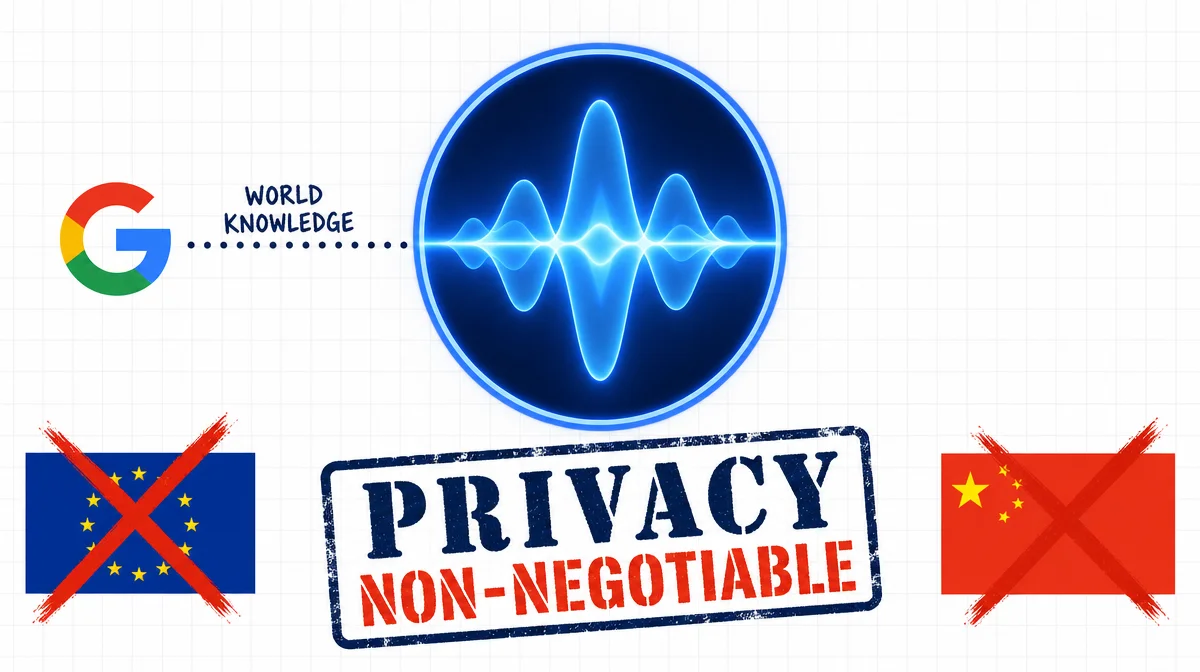
Apple says privacy is non-negotiable. Siri AI runs on Google.
Siri AI launched at WWDC 2026 — two years late, powered by Google Gemini for 'world knowledge,' unavailable in the EU and China (about 40% of Apple's revenue base), and syncing your conversation history through iCloud. Apple called it the world's most private digital assistant. The footnotes on that claim run three architecture tiers deep.
"Privacy in AI is non-negotiable," said Craig Federighi, at the exact same keynote where Apple announced Siri would run on Google Gemini.
Two years ago, Apple told the world it was rebuilding Siri from the ground up. At WWDC 2024 it promised a smarter, context-aware assistant powered by Apple Intelligence. A year later, most of it still hadn't shipped. On June 8, 2026, Apple tried again, this time with a new name — Siri AI — and a fresh set of marketing promises about the most personal, most private assistant ever built.
Let's go through what they actually announced.
What it does (and what that actually means)
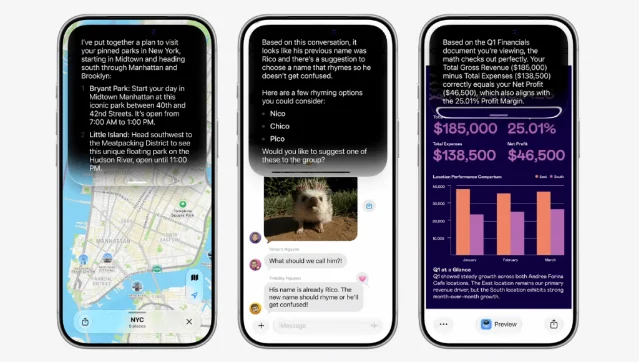
Siri AI can now pull from your emails, messages, photos, and calendar to answer questions. It reads your screen. It drafts emails in your voice based on how you usually write to a specific contact. It lives in the Dynamic Island. There's a dedicated standalone Siri app — essentially a ChatGPT-style conversation archive — synced across your Apple devices via iCloud. 2
On Mac and iPad, Visual Intelligence comes for the first time: you can control-click any image or text and ask Siri about it. On iPhone, there's a new "Siri mode" inside the Camera app where you point your phone at something and Siri describes, identifies, or acts on it.
That's the product. Now here's the mechanics underneath it.
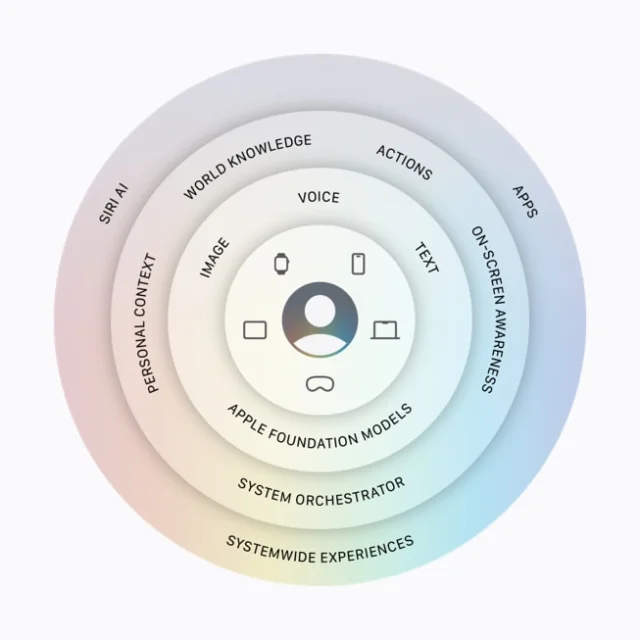
Siri AI is powered by two distinct layers. On-device tasks use Apple's own foundation models. For more complex queries, it routes to Apple's Private Cloud Compute servers. For broad world knowledge — essentially everything that makes the product feel like a real AI assistant rather than a clever contacts search — it uses Google's Gemini family of models. 3
Apple collaborated with Google to "develop the next generation of Apple Foundation Models," which is a careful way of saying Gemini does the heavy lifting when the on-device model can't.
"Privacy is non-negotiable" (terms and conditions apply)
Federighi's keynote line about privacy deserves its own paragraph because it is doing an enormous amount of work.
Apple's actual privacy architecture for Siri AI has three tiers: processing on your device, processing on Apple's Private Cloud Compute (where Apple says data is not stored and can be audited by external researchers), and then Google Gemini for broad world knowledge. The third tier is where Apple's privacy rhetoric gets soft. Apple says Gemini is only used for public world knowledge queries — not personal context — but the company has not published a clear technical specification of exactly which query types leave the Apple ecosystem and route to Google. 3
The conversation history — every back-and-forth you have with Siri AI — syncs through iCloud. That's Apple's cloud. The same iCloud that has produced government subpoena responses and law enforcement data disclosures before. Apple is explicit that Private Cloud Compute does not store your data during processing; it says nothing about the synced conversation archive.
"The world's most private digital assistant" is the product summary Apple published. The footnotes on that claim run about three architecture tiers deep.
The 40% problem
Siri AI is not available in the European Union on iPhone or iPad when iOS 27 ships later this year. Nor in China. 4
Maxim Group analyst Tom Forte put the number plainly after the keynote: as much as 40% of Apple's revenue could be affected by the Siri AI regions where it won't function. 5
Apple's own statement blames EU regulators. The DMA, Apple says, would force it to give any third-party AI system "nearly unlimited access" to users' devices — the ability to read messages, make purchases, execute actions across apps. Apple proposed a "Trusted System Agent" intermediary as a compromise and offered an 18-month phased rollout. The European Commission declined. So no Siri AI on iPhone or iPad in Europe, no timeline.
This framing positions Apple as a privacy defender heroically blocked by unreasonable regulators. An alternate reading: Apple built a system that requires deep OS-level integration and inter-app data access, and then discovered that the regulatory framework designed to prevent exactly that kind of lock-in applies to them too.
EU users will get Siri AI on macOS and visionOS 27. So if you live in the EU and want Apple's new assistant on the device that 95% of people actually use for their daily AI queries, the answer is: eventually, probably, no timeline. 4
Two years is a long time to be in beta
At WWDC 2024, Apple announced a smarter Siri powered by Apple Intelligence. At WWDC 2025, most of those promised features still hadn't shipped. TechCrunch's WWDC 2026 coverage opens with a subtext note from senior editor Sarah Perez: Apple spent WWDC "leading with fixes before features," framing a better Siri as "one item on a long list of improvements rather than the main event." 1
Siri AI will be available for developer testing now. It arrives as a beta to general users "later this year."
So the product that was supposed to ship in 2024, announced again in more limited form in 2025, is now shipping as a beta in the second half of 2026, unavailable in the EU and China, and not available on watchOS or iPadOS in the EU. Tim Cook used WWDC 2026 as his final keynote before handing off to John Ternus. He picked this product to close on.
콘텐츠 카드를 불러오는 중…
Verdict
Siri AI is real, not vaporware. The screen-awareness features, the camera integration, the conversation memory app — these are credible and, judging by the demos, functional. If you own an iPhone in the US, Japan, or Australia and you've been using ChatGPT on your phone as a workaround, this is probably the year Siri becomes genuinely usable.
But the product is a two-year-late, Google-powered, iCloud-synced assistant that Apple is selling as the most private AI ever built, that isn't available in 40% of the markets Apple sells phones in, and that ships as a beta to users "later this year." The gap between "privacy is non-negotiable" and "runs on Gemini, syncs to iCloud, blocked in the EU for OS-level data access reasons" is not a gap Apple addresses in any of its materials. It is the entire product.
"Non-negotiable" means you don't negotiate. Siri AI is the result of Apple negotiating with itself, with Google, with iCloud's architecture, and with three years of broken promises, and then announcing the outcome as a privacy landmark.
이 콘텐츠를 둘러싼 관점이나 맥락을 계속 보강해 보세요.